Make your own audiobook+Make your own audiobook
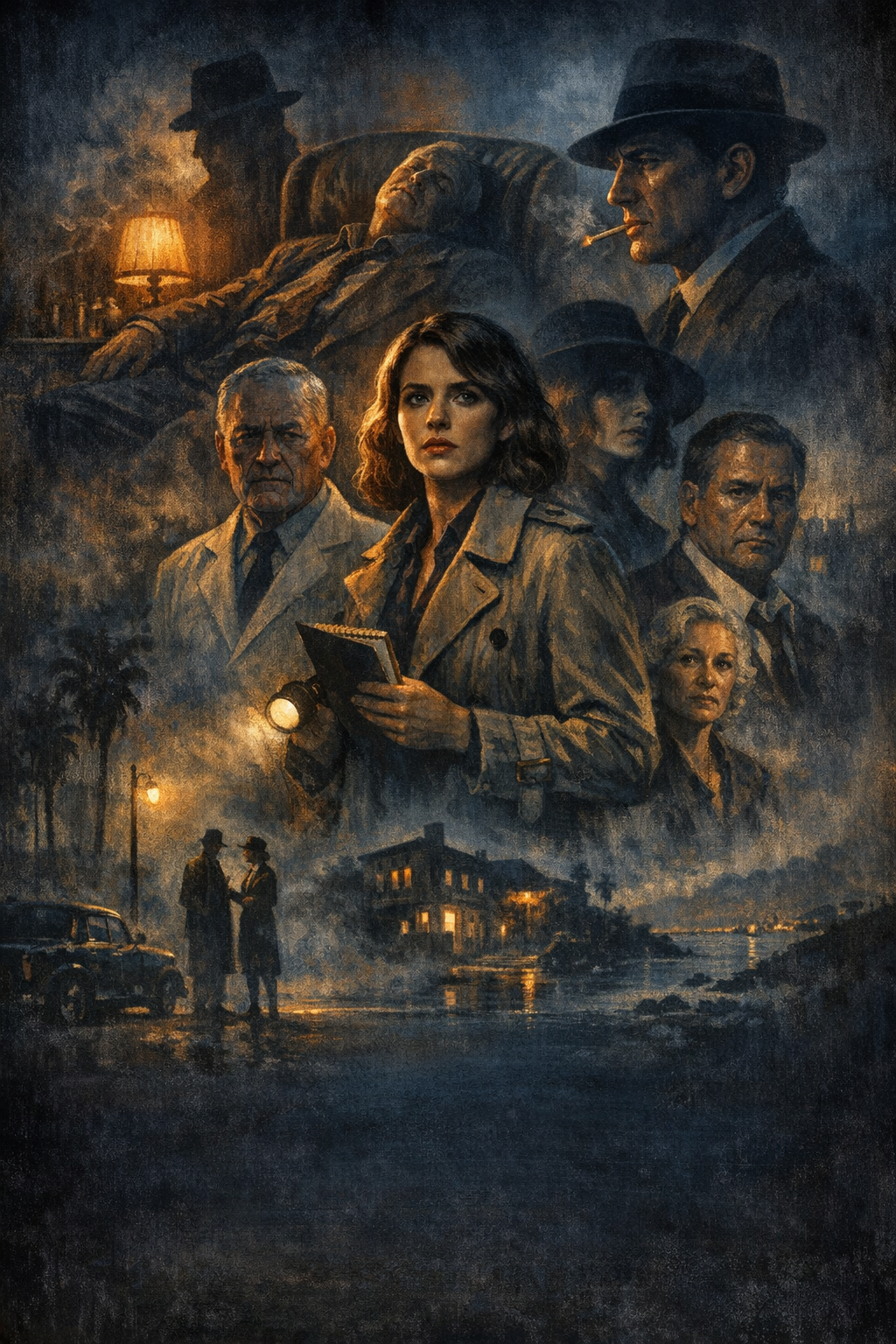
Poster for The Echo of Silence

The Echo of Silence

In 1944, the enigmatic Milbank Johnson, a retired businessman, is found dead under suspicious circumstances that leave the community reeling. As whispers of conspiracy surround his unexpected death, a young journalist, driven by her own battles with illness, delves into the history of the controversial cancer clinic he funded in San Diego. Through personal accounts and hidden records, she uncovers a maze of recovery, suspicion, and silence that leads her to question: was Milbank Johnson silenced for uncovering a cure, or was he just another casualty of hope?

Graphene
Written. Spoken. Yours.
Graphene
Written. Spoken. Yours.
←

The Echo of Silence

🥽 VR
2 chapters · ~9 min read

novella

In 1944, the enigmatic Milbank Johnson, a retired businessman, is found dead under suspicious circumstances that leave the community reeling. As whispers of conspiracy surround his unexpected death, a young journalist, driven by her own battles with illness, delves into the history of the controversial cancer clinic he funded in San Diego. Through personal accounts and hidden records, she uncovers a maze of recovery, suspicion, and silence that leads her to question: was Milbank Johnson silenced for uncovering a cure, or was he just another casualty of hope?

Made with EmberKiln
Chapter 1 · ~5 min read

Whispers in the Shadows

7:18

"He was alive on Tuesday. I saw him buy pears." The woman saying this is Mrs. Alma Petrie, sixty-one, a widow twice over, and she is standing on the sidewalk in front of Milbank Johnson's house with her grocery bag at her feet and a cantaloupe rolling slowly toward the gutter. She has already screamed once. Now she is explaining, to no one in particular, the arithmetic of a man she last saw choosing fruit. Above her, on the second floor, a crow has landed on the sill of the study window. It cocks its head at the glass. Whatever it sees inside, it considers, the way crows consider things, which is to say without hurry. Then it goes back to being a crow on a sill.

•••

The town is called whatever you need it to be called. It has one paper, one sheriff, two churches, a drugstore that still sells penny candy out of habit, and a main street that empties by eight. Milbank Johnson lived at the top of Juniper Street in a white house with green shutters and a brass knocker shaped like a lion's head, which he had brought back from somewhere he never fully explained. He was seventy-one. He had been retired for eleven years. In those eleven years he had funded a library wing, two scholarships, and one thing further away that people in town knew about and mostly did not discuss. By the time Clara Reyes arrived, there were already fourteen people on the sidewalk. She counted them. Counting was something she did when her chest felt tight, the way other people hummed.

•••

Clara was twenty-six. She wrote obituaries and the garden column for the Herald and had been told, twice now and gently, that the paper was tightening its belt. She wore a gray coat that had been her mother's and carried a reporter's notebook with a pencil threaded through the spiral. In her left pocket was a handkerchief, folded square. In her right was a second handkerchief, also folded square, because one was never enough anymore.

•••

She crossed the street at an angle that let her study faces without seeming to. Mrs. Petrie, still talking about pears. The milkman, who had set his crate down on the curb and had not picked it up. A man she did not recognize in a brown hat, standing far enough back from the others that he might have been waiting for a bus, if there had been a bus. And Sheriff Dale Cromer, broad in the shoulders and tired in the eyes, stringing a length of twine across the walkway because he did not yet have proper tape. "Clara," the sheriff said, without looking up. "Go home." "Is it true." "Go home, Clara." "Sheriff."

•••

He looked up then. He had known her father. He had carried her, once, out of a church pew when she was nine and had fainted during a long sermon in July. He saw, now, what he always saw when he looked at her, which was a girl who ought to be sitting down. "You don't need to be here for this," he said. "Go write about the roses." She did not answer. She was listening to the two women behind her, who were speaking in the particular hush people use when they want to be overheard by exactly one other person. "Well," one of them said. "He had enemies." "Hush." "I'm only saying what everyone's thinking." "Then don't say it yet."

•••
“

Counting was something she did when her chest felt tight, the way other people hummed.

A cough started low in Clara's chest and she turned her face into her shoulder and let it happen there, briefly, into the wool. When she looked up again the sheriff had moved three steps away to wave off a boy on a bicycle, and the front door of the house was open, and a deputy inside was crossing from one room to another with something in his gloved hands that Clara could not identify from the street. She pressed the handkerchief to her mouth and stepped over the twine. No one stopped her. That was the thing about looking like you might fall down. People's hands reached for you a half-second too late, and in that half-second you could be past them and up a staircase.

•••

The study was at the end of the hall on the second floor. She did not look at the body. She had decided, on the stairs, that she would not look at the body, not yet, not until she had seen the rest of the room, because the body would take the room away from her and she needed the room first. The desk was a wreck. Every drawer stood open. The bottom one had been pulled all the way out and set on the rug. Papers were strewn across the floor in the loose, careless way of something done quickly by someone who had not been afraid of being heard. A letter opener lay on the blotter. An inkwell, uncapped, had not spilled. The lamp was still on.

•••

She stood in the doorway and let her eyes move. A reporter learns, early, that the first look at a room is the only honest one. After that, the room begins to arrange itself for you. Someone had been looking for something. Someone had either found it or hadn't. From the doorway there was no way to tell which, and she thought, with a small clean clarity that surprised her, that finding out which was now the only thing she wanted to do with the rest of the week. A deputy noticed her. His mouth opened. "Miss, you can't," And then the sheriff's voice came up the stairs behind her, saying her name the way he had said it on the sidewalk, and she turned and let herself be walked out, because she had already seen what she needed to see and there was no sense spending the goodwill.

•••

On the sidewalk, Mrs. Petrie had finally picked up her cantaloupe. The man in the brown hat was gone. The sheriff said something to her about staying out of it that she agreed to without agreeing to, and she walked back down Juniper Street with her notebook still closed in her pocket, because she had not written anything down and did not need to. Behind her, on the second floor, the crow was no longer on the sill. The wind had picked up off the hills and was pressing against the house in long, even breaths. On the glass where the crow had been, a single black feather lay flat, held there by the weight of the evening air, trembling slightly, going nowhere.

•••
Next · Ch 2 →
The Unraveling Fabric
Chapter 2 · ~4 min read

The Unraveling Fabric

6:06

The clinic was called the Milbank Foundation Clinic for Cancer Research, and until a week ago, Clara Stone had never heard of it. This is worth saying out loud, because Clara had grown up ninety minutes north of its front door. She read three newspapers a day. She had, at twenty-two, written a column on municipal health funding that briefly made her unpopular with two city councilmen. And still: the clinic had operated for most of a decade in plain daylight, and she had not known it existed. That is the kind of silence that interests a certain kind of journalist. It is also the kind of silence that should make her more careful than she is about to be.

•••
“

That is the kind of silence that interests a certain kind of journalist.

Margaret Holloway's kitchen was the first stop. The second was a bungalow in Mission Hills, where a man named Howard Pritchard kept amber medicine bottles on his table the way other men kept salt and pepper. There were seven of them, lined along the oilcloth, labels faded to the color of weak tea. A plate of toast sat beside them, two triangles eaten, two gone cold. Clara set her notepad down. She uncapped her pen.

•••

Howard Pritchard was sixty-one and had been given, in the spring of 1940, somewhere between four and seven months to live. He said this the way other people said the weather had turned. He had gone to the clinic because a cousin's wife had gone, and the cousin's wife was still walking around. He had received what he called the treatments. He did not elaborate on what the treatments were, and when Clara asked, he waved at the bottles as if they answered the question. "They told me the names," he said. "I couldn't tell you now. I was too busy being alive to take notes." He laughed at this. Clara did not. She asked whether he had experienced side effects. He thought about it for a long time, long enough that she wrote the word thinking in her notebook and underlined it twice.

•••

"My hearing went," he said finally. "In the left ear. Not all at once. Over about a year. They said that wasn't them. Could've been anything, they said." "Could it have been." "Could have been." He nodded. "I'm still here." She heard Margaret in that sentence and did not say so. He would not give his name for print. He said this kindly, almost apologetically, as if declining a second cup of coffee. His daughter worked for one of the men who sat on the clinic's board, he explained, and she had three children, and he did not want to be the reason anyone's lunch got complicated. Clara wrote this down too. She wrote: declined, daughter's employer, board.

•••

She left Pritchard's house at eleven and was at a diner on India Street by noon, drinking coffee she did not want and reading back her own handwriting. Four interviews in two days. Four people who had been told they were dying. Three of them walking around. The fourth, a woman named Alma Reyes, had buried her husband eight months after his final visit to the clinic, and she wanted Clara to understand that her husband had been getting better, had been getting better, until suddenly he was not. Alma Reyes would go on record. She said so twice, with her hands flat on the table.

•••

And then, almost as an afterthought, she had said something that did not fit. She had said that her husband, in his last weeks, kept asking about a young man he'd met at the clinic. A kid, she said. Her husband had called him a kid. He had wanted to know whether the kid was still coming in. The staff had told him the kid had moved to Arizona for the dry air. Alma said her husband hadn't believed it, and she didn't know why, and she had not thought about it since the funeral until Clara asked. Clara had written the word Arizona in her notebook and drawn a small square around it.

•••

She did not know yet that the square was the beginning of something. She only knew that four people had described the same clinic and that the clinic they described could not be the same place. One of them was lying, or more than one, or none of them, which was the possibility that interested her most. She paid for the coffee. She walked out into the afternoon. The photograph was still in her coat pocket, folded once along the center, and she could feel the edge of it against her ribs when she breathed. Margaret had handed it to her yesterday without a word. Clara had not shown it to Pritchard. She had not shown it to Alma. She was not ready, yet, to find out what it would do to a face.

•••

She stood on the sidewalk a long moment. A streetcar went by. A woman passed her pushing a pram, and the baby inside was asleep with its mouth open, and Clara watched them go without really seeing them. She had come to San Diego for a death. She was going to stay for something else. She did not yet have the word for what the something else was, but she had Alma Reyes's name, and she had a square drawn around the word Arizona, and she had a photograph against her ribs that she was going to have to show to someone eventually. She started walking toward the trolley stop. She was not thinking about her editor. She was thinking about the kid.

•••
← Previous · Ch 1
Whispers in the Shadows
Back to show →
The Echo of Silence